
Sea turtles – our fabled friends
Sea turtles are probably one of the most well-known and beloved creatures of our vast oceans. Whilst they do breathe air, they can stay under water for around 40 minutes – or even up to several hours while they are asleep. As Reptiles, Turtles lay eggs. The females usually return to the beach where they were born.  On the beach, they dig hole in which they lay up to 300 eggs and then cover them up with sand and finally they camouflage them. This is the only protection those eggs will have, the mother returns back to the ocean right after laying her eggs. Those little guys unfortunately have very little chance of making it to adulthood. A lot of them will get eaten or won’t even make it to the ocean safely after hatching. But even if they do, more danger in form of predators awaits in the ocean. Luckily, enough make it so that we can observe them on almost every dive.
They have fascinated humans for several thousand years and appear in mythology and cultural depictions throughout all cultures. Usually, they symbolize wisdom, patience and a certain easy-going way of life as they can live to over a hundred years old with the exact life span depending on the species of sea turtle. In Africa the story goes that turtles are the cleverest of all animals and they gave the other creatures their colours. In Nigeria the turtle is known as a trickster and accomplishes heroic deeds through various different stories. Meanwhile in ancient Greek and Roman mythology the turtle symbolized fertility and was thus an attribute of the goddess Aphrodite/Venus. In Tahitian culture the sea turtle is the shadow of the gods and the lord of the ocean.
O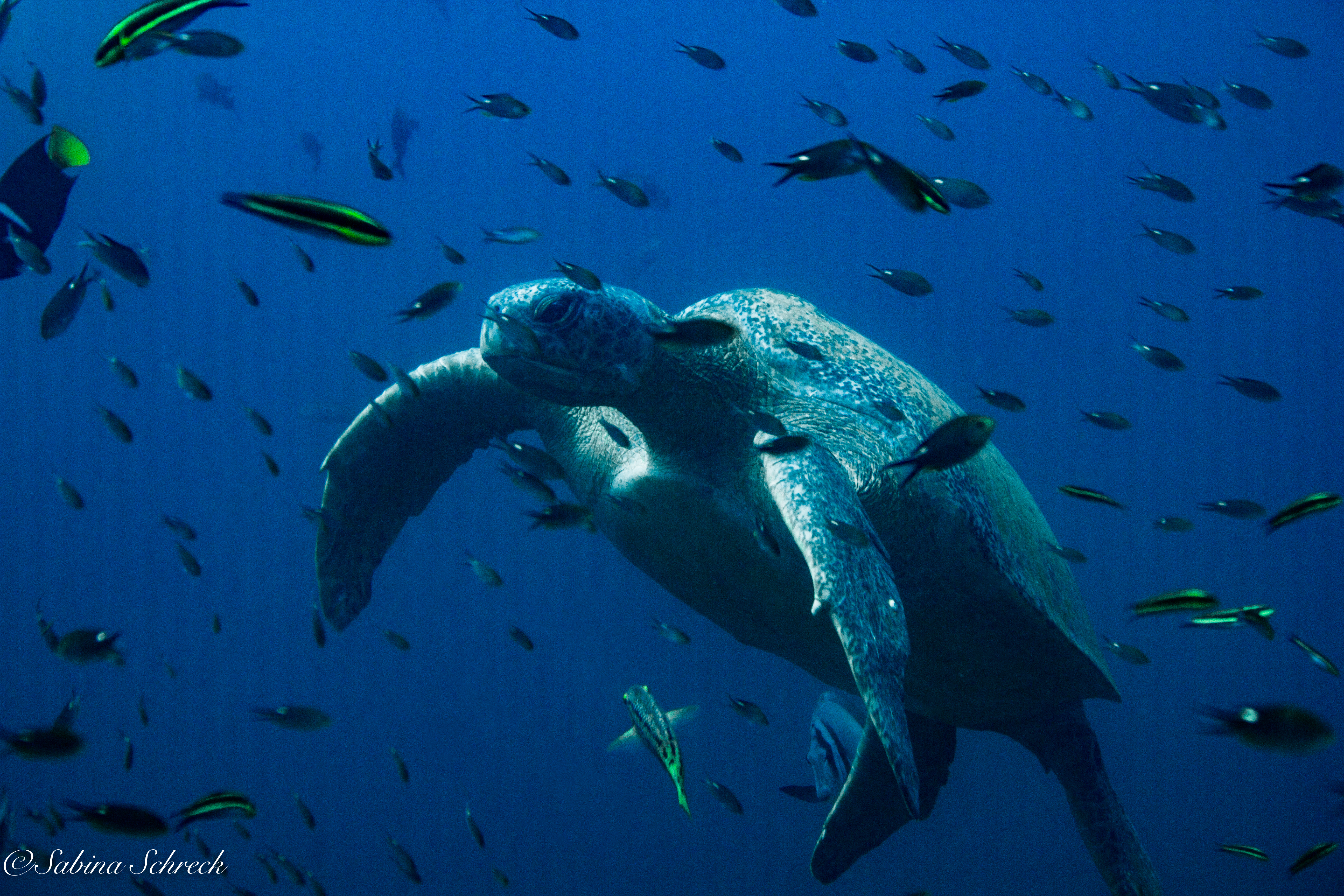 ften they are connected with creation myths: There are stories in which the turtle literally carries the world on its back; in some stories that turtle stands on the back of another larger turtle – it is “turtles all the way down”. In other stories our planet is carried by four elephants who stand on the back of a turtle. Unfortunately, in a metaphorical way, turtles really are carrying some of the weight of the world as they are one of the creatures impacted the most by climate change. The reason for this is that the gender of the little sea turtles hatching from their eggs on the beach is determined by the sand temperature. As a result, rising temperatures have led to a too high percentage of female sea turtles, in some areas it is as high as 95%. This makes reproduction even harder, and it is already not easy for our beloved creatures. Sea turtles take decades to reach sexual maturity. When they do return to the beach to lay their eggs the survival rates are unfortunately very low.
Sea turtles are not just the cute, calm creatures we love so much on our dives though – they have a real significance to the ecosystem. For instance, they eat the seagrass, keeping it short enough so it keeps spreading over the ocean floor providing an important habitat for lots of other species who find shelter and food in these grassy beds. They also eat jellyfish. The leatherback turtle is immune to the poison of the box jellyfish and hence controls its population keeping beaches safe for us humans as well.
In Coiba National Park one of the spots where we are most likely to find sea turtles is at the so-called cleaning stations that exist at certain dive sites, like Iglesia. At these cleaning stations fish eat the parasites inhabiting the sea turtles among other bigger animals like rays making it a mutually beneficial institution: they feed on the parasites and the sea turtles and rays get rid of those nasty little plagues. It is fascinating to observe such areas where the animals knowingly go to get cleaned off, and it is what makes Iglesia one of my favorite dive sites.
-Text and video by Saskia